Cart
0
Holiday Hunting Pressure Field Guide
How Holiday Hunting Pressure Affects Whitetail Deer Movement
Crowded access does not make deer disappear. Hunting pressure can change how much deer move, where they spend daylight hours, and which parts of a property they use to avoid people.
Photo: White-tailed buck in marsh habitat.
Irene Hinke-Sacilotto / U.S. Fish & Wildlife Service.
Public Domain.
When a major holiday weekend or Thanksgiving break hits during deer season, parking areas fill up before daylight, ATV trails wake up at dawn, and hunters who could not get into the woods during the workweek often arrive on public land and family farms at the same time.
Many hunters assume that sudden burst of human activity ruins the hunting— pushing every mature buck onto neighboring properties or turning the entire herd completely nocturnal.
Holiday hunting pressure does not make whitetails vanish. It changes risk—and deer can respond by reducing movement, tightening their use of cover, or shifting how they use familiar parts of their home range.
If you understand how deer respond when quiet woods suddenly become crowded, hunting pressure can become another piece of the pattern rather than simply a reason to leave.
What GPS-Collar Research Actually Shows
Research summarized by the Missouri Department of Conservation found that deer can alter movement in both space and time to reduce encounters with hunters. The same report notes that deer often remain in the general area rather than simply abandoning a property. Penn State GPS research has also documented home-range contraction in some deer during hunting pressure, although individual responses vary considerably.
01
The Sudden Spike Effect: Why Holiday Pressure Feels Different
During a normal midweek hunt, human intrusion may be scattered. Over a holiday stretch, access can arrive in a more concentrated wave— more vehicles, more walking, more repeated use of easy routes, and more activity near popular entry points.
- Acoustic & Vehicular Disruption: truck doors, UTV engines, voices, and footsteps can advertise human presence before hunters reach their stands.
- Repeated Use of Easy Access: ridge trails, field edges, logging roads, creek crossings, and parking-area approaches often receive the highest concentration of human traffic.
- Visible Movement in Open Cover: repeated human movement through open hardwoods or exposed field edges can encourage deer to favor cover where visual detection is harder.
Holiday Pressure Route
Concentrated Human Access
→
Easy Trails & Open Cover Carry More Risk
→
Deer Favor Low-Disturbance Cover Within Familiar Range
02
The Three-Phase Holiday Movement Cycle
A holiday weekend does not create one universal deer schedule. But human access often arrives in recognizable waves, and those waves can create localized disturbance at different times of day.
Dawn Access
Phase 1: The Morning Bump
Hunters entering before daylight may displace deer that are feeding near open areas or bedding close to popular access routes. Watch brushy drainages, side-hill cover, and secondary travel routes away from the main approach.
Late Morning / Midday
Phase 2: The Exit-Wave Opportunity
When hunters leave stands for vehicles, camp, or lunch, that movement can create a second localized disturbance. It does not guarantee a midday buck, but interior funnels and crossing points can become worth monitoring.
Late Afternoon
Phase 3: Security-Cover Staging
Pressured deer may spend more daylight time close to cover and delay exposure in open feeding areas. Staging cover just inside brush, wet edges, or timber can therefore matter more than the field itself.
Do Not Treat 10 AM–2 PM as a Guaranteed Rule
Penn State GPS data show that deer movement under hunting pressure varies by season and individual. During rifle season, average movement can be low through much of midday, although individual bucks still make substantial daytime moves. In early and mid-November rut data, Penn State also recorded strong buck movement from roughly 11 AM to 2 PM. In other words: staying through lunch can create opportunity, but the clock alone does not make the pattern.
03
Where Pressured Deer May Find Lower-Disturbance Cover
Hunting pressure does not send every mature buck to the same habitat. The useful question is simpler: where on this property is human access hardest, least convenient, or most frequently ignored?
Wetlands, Marsh Edges & Difficult Crossings
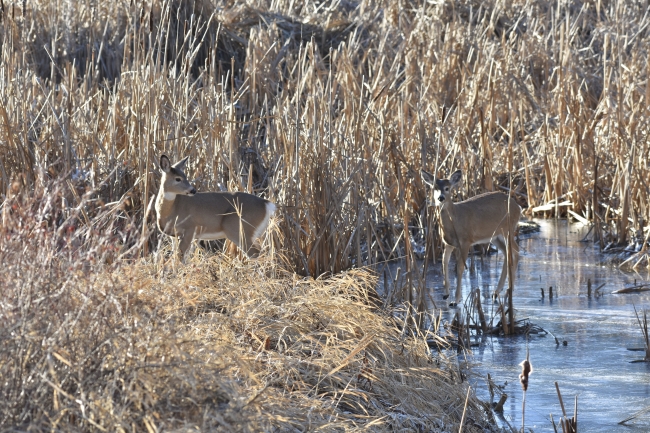
Water, mud, cattails, and poor footing can reduce casual foot traffic. Dry hummocks, brushy wetland margins, and cover beyond shallow barriers may therefore receive less disturbance.
Thick Creek Bottoms & Broken Terrain
Steep banks, dense vegetation, tangled creek corridors, and winding terrain can limit visibility and make hunter access less convenient.
Small Pocket Cover Near Human Infrastructure
Some overlooked cover exists surprisingly close to roads, parking lots, houses, or boundaries because hunters assume deer must be much deeper in the woods.
Why “Hard-to-Hunt” Matters
Penn State Extension reports that GPS-collared deer on public land can identify areas where they are unlikely to be disturbed and use those locations during hunting season. Another Penn State analysis found that hunting-pressure response more often appeared as a contraction of home-range use than a wholesale shift to a completely different property.
Midweek vs. Holiday Hunting Pressure Matrix
Think in terms of access risk and refuge availability, not a guaranteed holiday movement formula.
| Factor | Normal Midweek Hunt | Holiday Hunting Spike | Tactical Adjustment |
|---|---|---|---|
| Primary Disturbance | Scattered human activity mixed with natural movement drivers | Concentrated access, vehicles, repeated trail use | Identify escape cover and secondary routes away from obvious access |
| Daylight Opportunity | Often strongest around normal dawn / dusk activity periods | Localized disturbance can create additional daytime movement | Consider staying through midday rather than assuming the woods are dead |
| Daytime Cover | Normal bedding and security cover | Deer may tighten use of low-disturbance portions of home range | Study wet edges, dense cover, steep terrain, and overlooked pockets |
| Access Strategy | Standard paths may remain workable | Easy routes receive more repeated traffic | Use wind-aware, low-impact approaches and avoid joining the main human traffic pattern |
Holiday Pressure Gear Strategy
Gearing Up to Reach Wet Cover & Stay Through the Lull
Capitalizing on holiday hunting pressure often means two things: reaching overlooked cover without joining the main access pattern, and remaining comfortable enough to stay in position after other hunters begin leaving.
Crossing Wet Ground & Mud
If a low-impact approach includes wet grass, shallow mud, creek margins, marsh edges, or other messy terrain, tall waterproof rubber boots provide more lower-leg coverage than short leather hiking footwear.
Rubber footwear is also easy to rinse clean after muddy access. However, do not treat rubber boots as a guaranteed “scent barrier.” Wind direction, access route, disturbance, and how close you travel to bedding cover remain more important than footwear alone.
Staying Comfortable During Long Sits
Use Merino wool or synthetic socks rather than cotton in cold, wet late-fall conditions. Avoid overstuffing boots with multiple thick sock layers, which can reduce toe room and make feet feel colder.
Boat, Ramp & Transit Use
If your access involves a boat launch, wet dock, concrete ramp, or muddy shoreline, waterproof deck boots can be useful during loading and transit before switching into taller hunting footwear for the final approach.
Trudave Tall Waterproof Hunting Boots
Explore tall rubber and neoprene hunting boots
for mud, wet grass, marsh edges,
hunting access, farm ground,
and cold-weather outdoor use.
Explore Hunting Boots →
Trudave Waterproof Deck Boots
Explore WaveLock, DeckFlow,
Ocean Breeze, Seafarer Lite,
and other slip-on waterproof options
for boats, docks, ramps, and wet transit.
Explore Deck Boots →
Hunt the Risk Map, Not the Crowd
Holiday pressure does not create one universal deer response. Some deer reduce movement, some tighten their use of familiar cover, and some shift where they spend daylight hours.
The practical advantage comes from identifying where people are entering, which routes are being repeated, and where secure cover receives less disturbance.
Avoid the obvious traffic pattern, stay aware of the wind, remain patient when other hunters leave, and let pressure help reveal the portions of the property deer consider safest.
Whitetail Hunting-Pressure Research & Official Resources
Deer response to hunting pressure varies by habitat, individual behavior, season structure, road access, hunter density, and local regulations.
Missouri Department of Conservation
Deer Season Summary & Hunting-Pressure Research
Penn State Deer-Forest Study
Shift or Shrink? Deer Response to Hunting Pressure
Penn State Deer-Forest Study
Rifle-Season Deer Movement & Hunting Pressure
Penn State Extension
White-Tailed Deer Hide and Seek
U.S. Fish & Wildlife Service
White-Tailed Buck in Marsh — Public Domain Image
U.S. Fish & Wildlife Service
White-Tailed Deer in Wetland Habitat — Public Domain Image
Edited by Trudave.
White-tailed deer do not respond identically
to hunting pressure.
Movement, home-range use, bedding location,
and daylight activity vary by individual,
habitat, season, weather, access,
and hunter density.
Always check current state hunting seasons,
public-land access rules,
legal shooting hours,
and local equipment requirements before hunting.