Most hunters and anglers blame their aching knees and stiff lower backs on getting older. The real culprit? Outdated boot architecture that silently destroys your body's natural shock-absorption system.
It happens on the drive home. You’ve spent the entire day standing on the center console of a skiff or hiking through a flooded timber swamp. As you finally sit down in the driver’s seat, a dull, throbbing ache radiates from your lumbar spine, down through your knees, and into your heels.
The standard response is to swallow some ibuprofen and blame it on age, or simply accept that "outdoor work is hard on the body." But from a sports science perspective, this is a profound misconception. You aren't just tired; you are suffering from biomechanical trauma caused by the very gear you trusted to protect you.
The outdoor footwear industry has spent decades selling "toughness" through heavy materials and rigid structures. But when we analyze these legacy boots through the lens of human kinematics, the data is alarming. Your boots are actively disrupting your body's Kinetic Chain—the interconnected system of muscles, joints, and fascia that absorbs shock and propels you forward. Here is the clinical breakdown of how bad boots break the body, and how modern engineering fixes it.

1. The Pendulum Effect: The True Cost of Steel Shanks
For years, manufacturers embedded heavy steel plates (shanks) into the midsoles of boots, claiming it provided ultimate arch support. While a steel shank might stop a nail, it creates a biomechanical nightmare known as the Pendulum Effect.
Think of your leg as a pendulum swinging from your hip. When you add a heavy, rigid weight to the very bottom of a pendulum, it requires exponentially more energy to initiate and stop the swing. Every extra ounce on your foot translates to roughly four times that weight in strain on your hip flexors and lower back.
"You aren't hiking; you are dragging anchors. The rigid steel shank forces your lower back to absorb the impact that your foot's arch was biologically designed to handle."
The Ergonomic Solution: Modern engineering has eradicated the steel shank. By utilizing high-density, shock-absorbing composite EVA midsoles, the boot flexes naturally with your metatarsals. This restores the foot's natural rolling motion, drastically reducing the kinetic load transferred to your lumbar spine.
2. "Toe Clench" and Plantar Fasciitis
Why do your calves cramp, and why do the bottoms of your feet burn after a day in rubber boots? It usually boils down to a sizing failure. Legacy brands rely on "standard shoe sizes," which are notoriously loose in the heel for slip-on boots.
When your heel slips up and down even a fraction of an inch, your brain subconsciously commands your toes to clench downward to grip the insole and keep the boot from falling off. You are doing thousands of micro-crunches with your toes every hour. This constant, unnatural tension inflames the plantar fascia—the thick band of tissue running across the bottom of your foot—and sends radiating cramps up into your calf muscles.
The Ergonomic Solution: You must abandon standard shoe sizes. Sizing a boot based on your actual foot measurement in inches maps the boot's internal cavity directly to your anatomy. A mathematically precise fit locks the heel, allowing the toes to relax, and instantly neutralizing the risk of plantar fasciitis.
3. The Restriction of the Achilles (The Tall Boot Flaw)
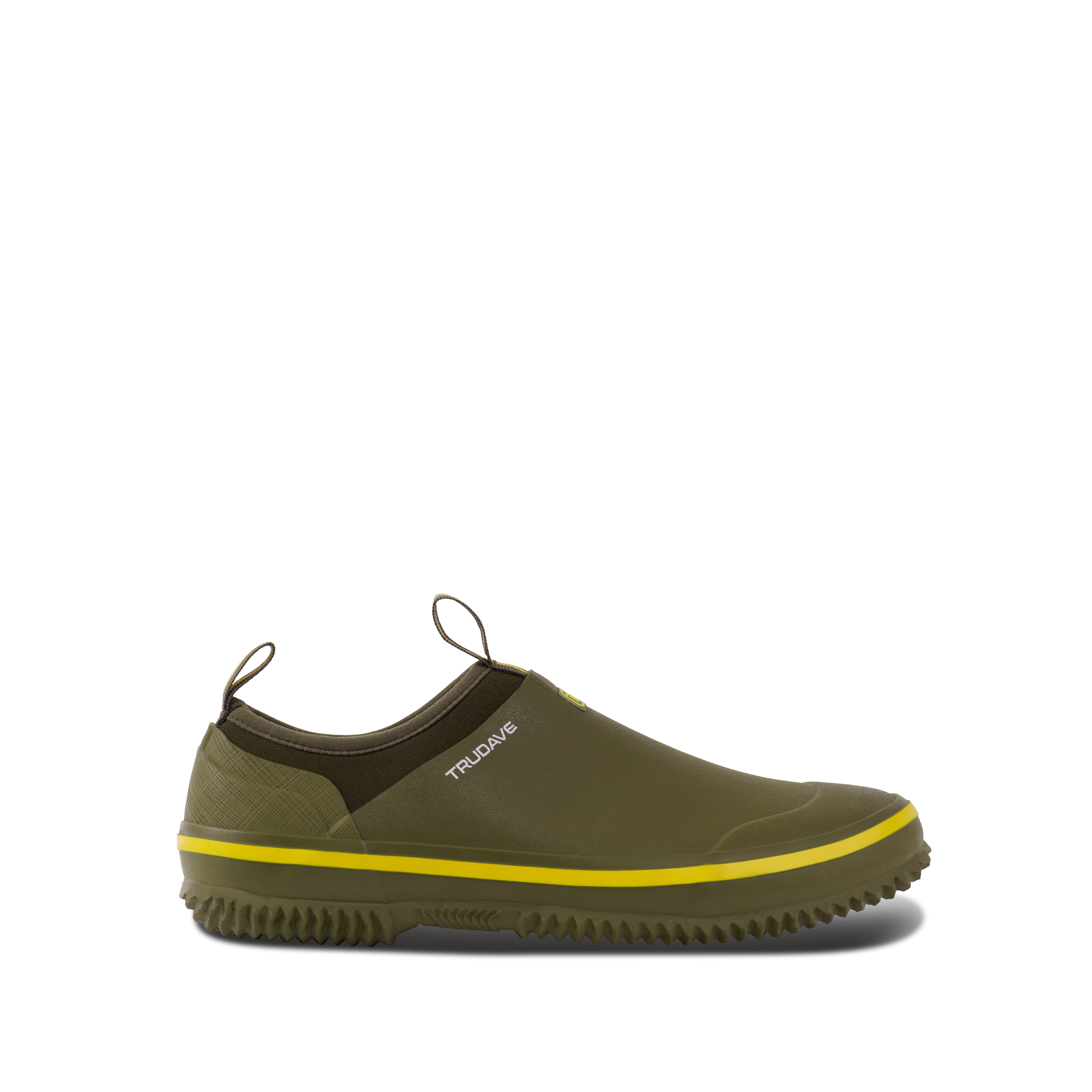
There is a persistent belief that a waterproof boot must reach all the way to your knee to be effective. However, from a kinematic standpoint, wrapping the thickest part of your calf in rigid rubber acts like a medical splint.
Your calf muscle (gastrocnemius) and Achilles tendon are your body's primary shock absorbers. When you restrict their ability to expand and flex inside a tight, knee-high boot, that kinetic energy bypasses the calf and shoots directly into the knee joint. This is why knee-high boots inevitably lead to patellar tendinitis (runner's knee) in the field.
Kinetic Impact: Legacy vs. Engineered Footwear
| Structural Flaw |
Biomechanical Consequence |
Modern Engineering Fix |
| Heavy Steel Shank |
Hip Flexor & Lumbar Fatigue |
Zero-Steel EVA Midsoles |
| Loose Heel Sizing |
Plantar Fasciitis (Toe Clench) |
Inch-Based Precision Sizing |
| Knee-High Shaft |
Knee Joint Impact (Restricted Calf) |
Mid-Calf / Ankle Profiles |
| Male-Only Lasts |
Female Arch Collapse |
Dedicated Female Architecture |
4. The Gender Gap in Biomechanics
If you are a female angler or hunter, the physical toll is often worse. The industry's long-standing practice of "shrink it and pink it"—taking a men's boot mold and simply making it smaller—ignores human anatomy.
Women possess a different Q-angle (the angle between the hip and the knee) and generally have narrower heels. When forced into a boot built on a men's last, the foot pronates unnaturally, causing rapid arch collapse and severe hip pain. Premium female outdoor footwear must be built on a dedicated female last to ensure proper biomechanical alignment.
The Final Diagnosis
Pain in the outdoors is not a badge of honor; it is a symptom of failing equipment. Your boots should act as an extension of your body's natural suspension system, not an obstacle to it.
By demanding footwear that respects human kinematics—lightweight EVA over steel shanks, mid-calf profiles over knee-high casts, and inch-based precision over sloppy standard sizes—you aren't just buying boots. You are investing in your physical longevity.