Photo: Anglers fishing for Fall Chinook salmon on the Columbia River. Ryan Hagerty / U.S. Fish & Wildlife Service. Public Domain.
The Pacific Northwest is the ultimate proving ground for anglers. Chasing chrome Chinook and aggressive Coho up coastal rainforest streams and massive glacial rivers is a physical, demanding pursuit. The fish are powerful, the weather is notoriously unforgiving, and the rivers are inherently dangerous.
In the PNW, wading is not a casual stroll through a manicured trout stream. It is a battle against heavy currents, moss-covered bowling ball rocks, and freezing glacial runoff. If your footing fails or your waterproofing leaks, your day is instantly over. Successfully navigating these waters requires a deep understanding of the river mechanics and gear that refuses to quit.
01
Reading the Water: Where to Step and Where to Fish
Salmon migrate upstream in surges, using specific parts of the river to rest before pushing through rapids. Wading efficiently means reading these water structures for both safety and fish location.
-
Tailouts and Seams: Salmon hold in the softer water at the tail end of a pool (tailouts) or along the seams where fast current meets slow current. Wade along the shallow gravel bars inside the bends to cast into these holding zones without stepping into the danger zone.
-
The "Knee-Deep" Rule: Heavy PNW flows are deceptive. Water moving at a walking pace above your knees has enough hydraulic force to sweep your feet out from under you. Always keep your center of gravity low and side-step slowly when crossing seams.
-
Avoid the "Frog Water": Deep, stagnant pools are tough to wade safely and rarely hold active, biting fish. Stick to the transitional gravel bars where you have solid footing and access to moving current.
River Safety Note
Do not use depth alone to decide whether a crossing is safe. U.S. Fish & Wildlife Service guidance recommends assessing current speed, submerged hazards, the exit point, river bends, recent rain or snowmelt, and your own ability before committing. If the water is moving faster than you can walk or the crossing exceeds your comfort level, turn around. Read the USFWS river-crossing guide.
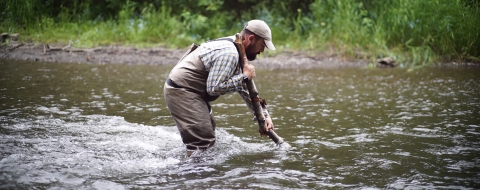
USFWS demonstration of the tripod river-crossing method: face into the current, maintain a stable stance, and use a sturdy pole to probe depth and add a third point of contact.
02
The Traction Factor: Defeating "Greasy" Rocks
The defining characteristic of a classic PNW freestone river is the rocks. They are round, uneven, and covered in a thick layer of slick algae and moss.
-
Traction is Non-Negotiable: Rubber-soled hiking boots will not survive here. You need aggressive wading boots equipped with tungsten carbide studs, aluminum cleats, or high-friction felt to cut through the slime and grip the rock face.
-
Ankle Stabilization: Wedging your foot between two unseen boulders in fast-moving water is a guaranteed way to roll an ankle. Heavy-duty, structured wading boots provide the rigid lateral support necessary to lock your ankles in place when you take a bad step.
Before You Choose Felt
Check local regulations before using felt-soled footwear. Some jurisdictions restrict felt because it can transport invasive organisms between waterways. Cleaning and drying wading gear between rivers is also good practice regardless of sole type. USFWS specifically notes that felt rules vary by location.

Chinook salmon moving upstream through Dagger Falls. Photo: NOAA Fisheries. The image underscores why current, gradient, and river structure matter when targeting migrating salmon.
03
Thermal Defense Against Glacial Melt
Even during the peak September and October fall salmon runs, the water in rivers like the Skagit, Cowlitz, or coastal rainforest streams is bone-chillingly cold.
-
Breathable vs. Neoprene: While heavy 5mm neoprene waders offer maximum insulation for deep winter steelhead, breathable, multi-layer waders are the superior choice for early fall salmon. They allow you to hike miles through dense blackberry brambles and muddy trails without overheating, while leaving enough room to layer heavy Merino wool underneath for the icy water.
-
Puncture Resistance: Bushwhacking through PNW coastal forests means navigating thorns, jagged deadfall, and sharp rocks. Flimsy waders will shred on the first hike in. You need reinforced knee and shin panels to survive the brush.
Cold Water Changes the Risk
The National Weather Service warns that cold-water immersion can trigger involuntary gasping, rapid breathing, loss of muscle control, and impaired judgment. Dress for the water temperature, not just the air temperature, and check conditions before entering a river. See NWS Cold Water Safety.
PNW Wading Environments: Coastal Streams vs. Big Rivers
Different water means different movement, traction, and waterproofing priorities.
Salmon Migration Context
NOAA Fisheries notes that adult Pacific salmon migrate from the ocean back to freshwater spawning habitat, and migration timing is influenced by both genetics and environmental conditions. River flow, temperature, passage barriers, and habitat all shape how and when fish move. NOAA Pacific Salmon Life History Research.
Gear Up for the Grind
Match the Lower Half to the Water You Are Actually Fishing
Chasing PNW salmon means committing to the grind. You will hike through rain, bust through heavy brush, and stand in freezing water for hours waiting for the bite. Your gear cannot be the weak link.
Whether you are pulling on heavy-duty, puncture-resistant waders for a deep river session, or sliding into a pair of Trudavegear’s waterproof tall rubber boots to cast from a muddy estuarine bank, ensure your lower half is matched to the actual water depth and terrain. Keep your feet dry, lock your traction to the riverbed, and stay out there until that rod tip buries into the water.
Official PNW Salmon & Wading Resources
River conditions and salmon regulations can change quickly. Use these sources before heading out.
Edited by Trudave. This guide is intended for general gear and outdoor-use information. Always verify current river conditions, local access rules, fishing seasons, emergency closures, and footwear restrictions before entering the water.