As the calendar flips to September 2026, the countdown to hunting season is in full swing. Early fall brings crisp mornings, changing leaves and some of the best days of the year to spend in the timber. It can also deliver a frustrating mix of warm afternoons, soaked vegetation, sudden rain and chilly mornings.
That weather swing is not just campfire talk. The U.S. National Weather Service explains that dew is favored by clear skies, light wind and available soil moisture , and also notes that fall's longer nights can create favorable conditions for dew and frost. For hunters moving through grass, brush and food plots before sunrise, that can mean wet footwear even when it never actually rains.
Field sources used in this guide: U.S. National Weather Service · The Woolmark Company · Boone and Crockett Club · LaCrosse Footwear · Irish Setter
01
Temperature Management
The Early Fall Dilemma: Waterproofing vs. Sweat
One of the easiest early-season mistakes is wearing footwear designed for stationary, cold-weather hunting during a warm, high-output scouting trip. Insulation is useful when conditions justify it, but more insulation is not automatically better.
The Winter-Boot Trap
Boots with heavy insulation can be valuable later in the season, particularly when hunters spend long periods sitting in low temperatures. During warm September walks, however, they may retain more heat than an active hunter needs.
That matters because moisture generated inside the boot can become uncomfortable once activity stops and temperatures fall.
The Early-Fall Sweet Spot
For mild weather and frequent walking, look first at non-insulated or lighter-insulation options and then match your sock system to the day's temperature and activity level.
Neoprene can provide flexibility and a thermal buffer, but it should not be treated as a substitute for moisture management. The sock and interior lining still matter.
In practical terms, this means early-season hunters should think in systems: waterproof boot + appropriate insulation level + moisture-managing sock, rather than choosing the warmest boot on the shelf.
02
What Matters in the Field
Four Features Worth Prioritizing in 2026
A good early-fall hunting boot has to do more than keep water out. The way the boot fits, supports the foot, grips soft ground and handles repeated exposure to mud can matter just as much over a long day.
01 · Coverage
Tall Waterproof Protection
Wet vegetation is one of early fall's most reliable ways to soak footwear. If your access route includes knee-high grass, marsh edges, ditches or shallow creek crossings, a tall rubber/neoprene boot provides more practical coverage than a low-cut hiking shoe.
The exact height you need depends on terrain, but boots in roughly the 15–18 inch range are common across dedicated rubber hunting designs. LaCrosse Alphaburly Pro official specs ↗
02 · Support
Midsole Cushioning and a Secure Heel
Avoid thinking of every rubber boot as a flat rubber tube. Modern hunting boots can use EVA or composite midsoles, structured footbeds and heel-retention geometry to make longer walks feel more controlled.
LaCrosse, for example, lists an EVA midsole and contoured heel fit in the Alphaburly Pro family, while Irish Setter uses its lightweight RPM composite midsole on selected MudTrek styles.
Those design details are more meaningful than vague claims such as “eliminates back pain.” Look for measurable construction features instead.
03 · Scent
Easy-to-Clean Surfaces — But Still Play the Wind
Rubber has a practical advantage for scent-conscious hunters: the exterior is non-absorbent and easy to rinse clean after walking through mud, fuel residue, agricultural areas or other contaminated surfaces.
But no boot makes a hunter “scent-proof.” Boone and Crockett's whitetail guidance emphasizes that deer rely heavily on smell and that hunters still need to pay attention to wind direction. Boone and Crockett Club — deer senses ↗
04 · Traction
Open, Mud-Shedding Lug Patterns
Rain can turn clay roads, creek banks and food plots into slick ground quickly. Look for pronounced lugs with enough spacing to release soft soil rather than packing it tightly into the tread.
This is not just marketing language: both LaCrosse and Irish Setter describe mud-shedding tread designs on current rubber hunting models. Irish Setter MudTrek official specs ↗
03
Boot Style Comparison
Which Early-Fall Boot Style Fits Your Hunt?
There is no universal winner. A treestand hunter crossing a wet field has different footwear needs from someone covering several miles while scouting public land.
| Boot Type |
Best For |
Why It Works |
Watch For |
Traditional Tall Rubber Boot
Example: LaCrosse Alphaburly Pro
|
Treestands, swamps, wet farm ground, creek crossings |
High shaft coverage, easy-to-clean exterior and aggressive traction |
Some models are heavier or more insulated than necessary for long warm-weather walks |
Support-Oriented Rubber Hunting Boot
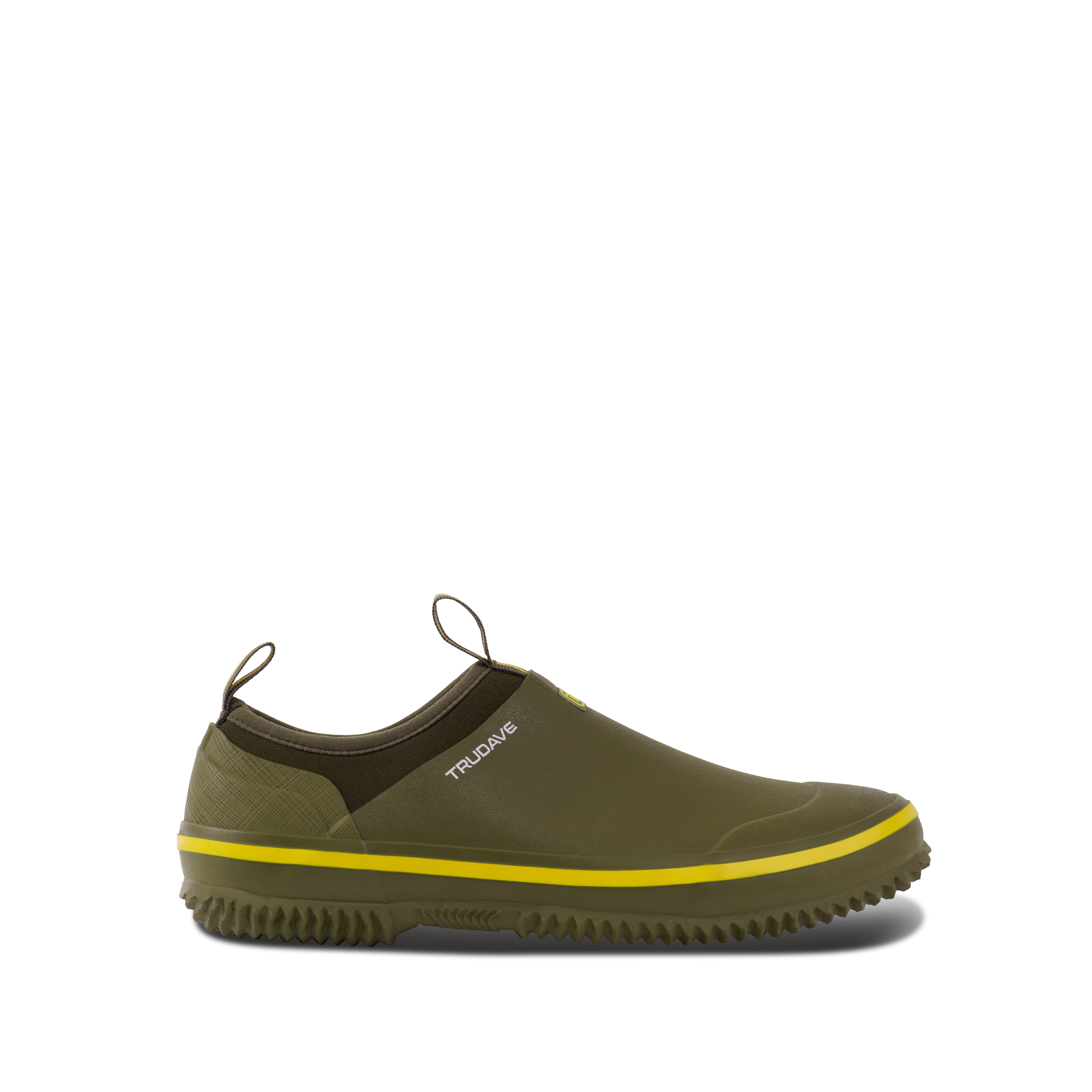
Example: Trudave Hunting Boots
|
Property prep, trail cameras, early archery, general wet-weather hunting |
Waterproof rubber/neoprene construction paired with more structured underfoot support |
Check the exact model's insulation, fit, height and outsole rather than assuming every style performs identically |
Lightweight Waterproof Hunting Boot
Example: Irish Setter Terrain A2712
|
Mobile hunting, scouting, uneven terrain and hunters who prefer a lighter lace-up boot
|
Waterproof leather construction with a lightweight high-rebound EVA midsole,
cushioned footbed and multi-directional outsole for traction and ankle stability
|
Lower shaft coverage than tall rubber boots, making it better suited to active hunting
than deep mud, marshes or higher creek crossings
|
04
Before Opening Day
Practical Early-Season Boot Tips
-
Fit the boot with the socks you actually hunt in. A secure heel is useful, but the toe box should not feel cramped. If you plan to use substantially thicker socks later in October, account for that extra volume without automatically buying an excessively loose boot.
-
Break boots in before the first serious hunt. Even pull-on rubber boots benefit from a few property walks before opening day. This gives you time to identify heel movement, pressure points and sock combinations that do not work.
-
Clean mud off after use. LaCrosse's official care guidance recommends cleaning visible dirt and mud with mild soap before conditioning the rubber. LaCrosse rubber-boot care guide ↗
-
Store tall rubber boots upright. The same LaCrosse care guide advises against folding tall boots and warns that heat, sun and repeated temperature changes can contribute to rubber deterioration.
The Bottom Line
For Early Fall, Balance Beats Maximum Insulation
September and early October can expose a hunter to warm walks, soaked grass, muddy access routes and sharply cooler mornings in the same trip. The most useful hunting boot is the one that matches that combination instead of simply providing the highest insulation number.
Prioritize dependable waterproof construction, enough shaft height for your terrain, underfoot support, a secure fit and an outsole that can deal with mud. Then use your sock system and insulation choice to fine-tune warmth.
For hunters who regularly work through wet grass, soft ground and shallow water, Trudave's rubber and neoprene hunting-boot lineup offers options built around the same early-season priorities: waterproof protection, traction and field-ready support.
Explore Trudave Hunting Boots →