We've sent you an email with a link to update your password.
Reset your password
We will send you an email to reset your password.
Waterproof vs. Breathable Rain Gear: Which Matters More?
TrudaveGear
Foul-Weather Gear Lab · Rain Protection
Waterproof vs. Breathable Rain Gear: Which Matters More for Outdoorsmen?
Rain gear has two jobs that constantly compete with each other: keep
weather from getting in while allowing heat and moisture generated by
your body to get out. The right balance depends less on the biggest number
printed on a hang tag and more on how, where, and how hard you move.
Rain OutWaterproof barrier, seams, closures and coverage
Sweat OutBreathability, ventilation and moisture management
Whether you are packing into elk country, running a bass boat through a
cold downpour, sitting in a duck blind, or scouting wet timber, your rain
shell becomes the barrier between your clothing system and the weather.
That is why outdoor shoppers constantly encounter the same debate:
waterproofness versus breathability.
Waterproof ratings may be expressed in millimeters, while some brands
publish breathability figures in grams. Those specifications can be
useful, but they should not be treated as a universal scoreboard.
The more useful question is:
What type of moisture is most likely to make you wet during your
specific activity?
Moisture Equation
The Two Ways You Get Wet Outdoors
Staying dry requires controlling moisture on both sides of the shell.
Outside → Inside
External Moisture
Rain, sleet, wet snow, boat spray, dripping vegetation and water
pressing against fabric while you sit or kneel.
VS.
Inside → Outside
Internal Moisture
Heat and perspiration generated while climbing, hiking, paddling,
dragging game, setting decoys or carrying heavy equipment.
Scenario 01
When Waterproofness Matters More
The more water hitting your body—and the less heat you are generating
through movement—the more important reliable waterproof construction
becomes.
Rain Out
Maximum Priority
Boat Runs, Duck Blinds and Sustained Heavy Rain
When you are sitting relatively still while cold rain or spray
continuously hits your outer shell, external water is the dominant
problem.
Open-boat fishing in driving rain and spray
Stationary waterfowl hunting
Working around saturated brush and vegetation
Kneeling or sitting on wet ground
Extended exposure with limited opportunity to dry clothing
Look For
Shell Construction
A Membrane Is Only Part of the System
Waterproof performance also depends on seam sealing, zipper design,
hood coverage, cuffs, hem adjustment and how well the garment fits
over the layers underneath it.
Fully taped or sealed critical seams
Storm-protected closures
Adjustable cuffs and hood
Enough length to protect your lower layers
A durable face fabric suitable for the terrain
Scenario 02
When Breathability Matters More
During high-output movement, a completely waterproof shell is not useful
if heat and perspiration accumulate inside faster than the system can
release them.
Sweat Out
Maximum Priority
Mountain Hunting, Hiking and Active Scouting
Climbing elevation with a loaded pack can generate significant heat,
even when the outside air feels cold.
Backcountry elk and deer hunting
Long approaches into public hunting land
Active fly fishing and river walking
Scouting through wet vegetation
Paddling or portaging equipment
Look For
Moisture Control
Breathability Plus Mechanical Ventilation
Even a high-performance waterproof/breathable membrane can be
overwhelmed during intense exertion. Features that physically dump
heat can therefore be just as important as the membrane itself.
Pit zips or underarm ventilation
Two-way front zippers
Adjustable cuffs
Mesh-backed ventilation areas
Room for moisture-managing base layers
Technical Breakdown
How Can a Fabric Be Waterproof and Breathable at the Same Time?
Modern rainwear commonly uses a membrane or coating beneath the outer
face fabric. The system is engineered to resist liquid water entering
from outside while allowing water vapor generated by perspiration to move
outward.
Face Fabric
Provides abrasion protection and is commonly treated to help water
bead rather than saturate the outer surface.
Membrane / Coating
Creates the primary waterproof barrier while permitting varying
levels of moisture-vapor transfer.
Inner Protection
A liner, printed layer or bonded fabric protects the waterproof layer
from body oils, abrasion and contamination.
Field Priority Matrix
Waterproof vs. Breathable Performance by Activity
Use your activity level and expected water exposure—not just the weather
forecast—to decide which side of the equation deserves more weight.
Outdoor Scenario
Exertion
Main Moisture Threat
Priority
Practical Setup
Offshore Fishing / Boat Run
Low–Moderate
Driving rain, spray and wind
Waterproof
Fully seam-taped shell + waterproof deck boots with wet-surface
traction
Backcountry Elk / Deer Hunt
High
Perspiration plus variable rain
Breathability
Waterproof/breathable shell + mechanical ventilation + technical
base layers
Flooded Timber / Marsh Hunt
Low–Moderate
Rain, standing water and wet vegetation
Waterproof
Waterproof outer shell + waders or tall waterproof footwear
appropriate for water depth
Early-Season Bank Fishing
Moderate
Light rain, dew, wet grass and body heat
Balanced
Lightweight waterproof/breathable shell + rubber utility or deck
boots
Hiking in Continuous Rain
High
Rain outside and sweat inside
Balanced
Durable waterproof/breathable shell with pit zips and adjustable
venting
Three-Question Test
Which Matters More for Your Next Trip?
Question 01
How Hard Will You Be Moving?
The harder the climb, hike, paddle or pack-out, the more important
breathability and active ventilation become.
Question 02
How Much Water Will Hit You?
Sustained rain, boat spray and saturated vegetation push
waterproofness and seam protection higher on the priority list.
Question 03
Will You Be Able to Adjust?
A shell with usable ventilation and layers that can be removed gives
you more control when weather and exertion change throughout the day.
Breathability Is Not Just a Fabric Specification
Outdoorsmen sometimes focus so heavily on membrane ratings that they
overlook the simplest way to remove heat: opening the garment.
Mechanical ventilation can dramatically change comfort during active use.
Pit Zips
Quickly release heat from high-output areas.
Front Zipper
Allows rapid cooling when precipitation temporarily eases.
Adjustable Cuffs
Open for airflow or tighten when rain intensity increases.
Layer Control
Remove insulation before a hard climb instead of waiting until you are
already sweating.
Build the Full System
Rain Protection Does Not Stop at the Jacket
A highly technical shell cannot keep the rest of your clothing system dry
if water enters through your pants, footwear or exposed openings.
Step 01
Protect the Core
Use waterproof/breathable outerwear appropriate for the expected rain
intensity and activity level.
Step 02
Seal the Lower Body
Rain pants prevent runoff from soaking pants and channeling water
directly into footwear.
Step 03
Protect Your Feet
Rubber deck boots or taller waterproof boots handle spray, puddles,
mud and wet launch areas.
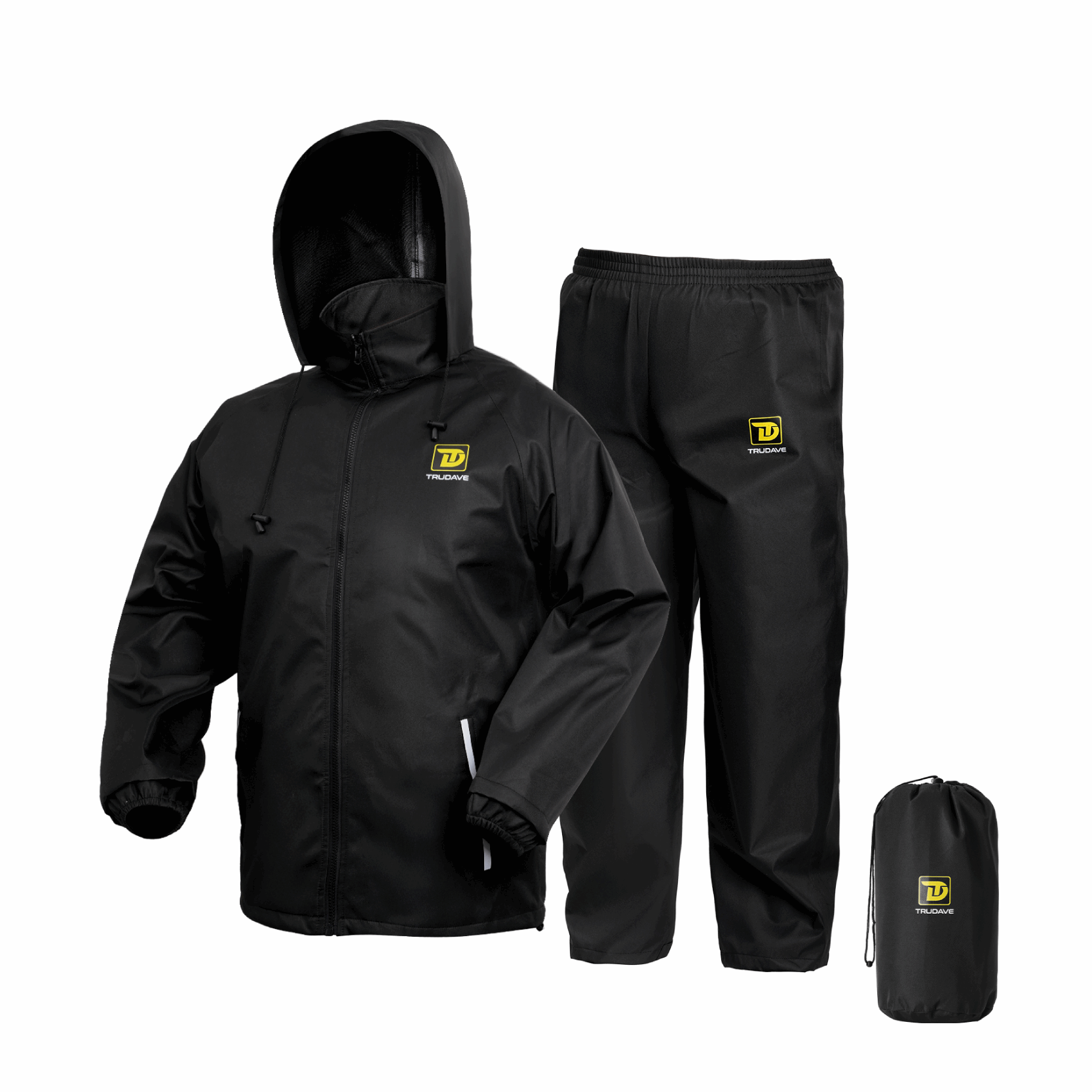
Trudave Weather Shell
TrailBlaze Waterproof Breathable Rain Suit
The TrailBlaze system combines a coated weather-resistant shell,
seam-taped construction and a breathable inner layer in a lightweight
two-piece design for fishing, hunting, outdoor work and sudden
foul-weather conditions.
Fully seam-taped waterproof construction
Breathable inner layer designed to reduce clamminess
Stowaway hood and adjustable cuffs
Lightweight, packable two-piece design
Adjustable pant cuffs for use over waterproof footwear
So, which matters more: waterproofness or breathability?
If you are sitting in heavy rain, running a boat through spray or working
in saturated marsh vegetation, waterproof construction deserves the
priority.
If you are climbing mountains, hiking with a loaded pack or moving hard
through light rain, moisture generated inside your shell can become the
bigger problem—making breathability and ventilation increasingly
important.
For most outdoorsmen, however, the goal is not choosing one and ignoring
the other. It is building a complete system that balances a dependable
waterproof barrier with enough vapor transfer and ventilation for your
activity level.
Match your shell to the weather, your ventilation to your workload and
your footwear to the ground beneath you. That combination will usually
matter more in the field than chasing the largest technical number printed
on a product tag.
With over a decade of experience tracking game across rugged North American terrains, Jack knows exactly what it takes to thrive in the wild. He specializes in rigorous field-testing for hunting apparel, boots, and waders, combining his passion for authentic wilderness survival with expert gear reviews and practical tracking techniques.
HUNTING GEAR
52% OFF
Quickshop
Fully Waterproof Build: Neoprene shaft bonded to a camo rubber shell for...